Announcements/Job Postings
- Welcome to the 8th official adhesion GPCR consortium newsletter! We welcome suggestions, feedback, and announcements from the community.
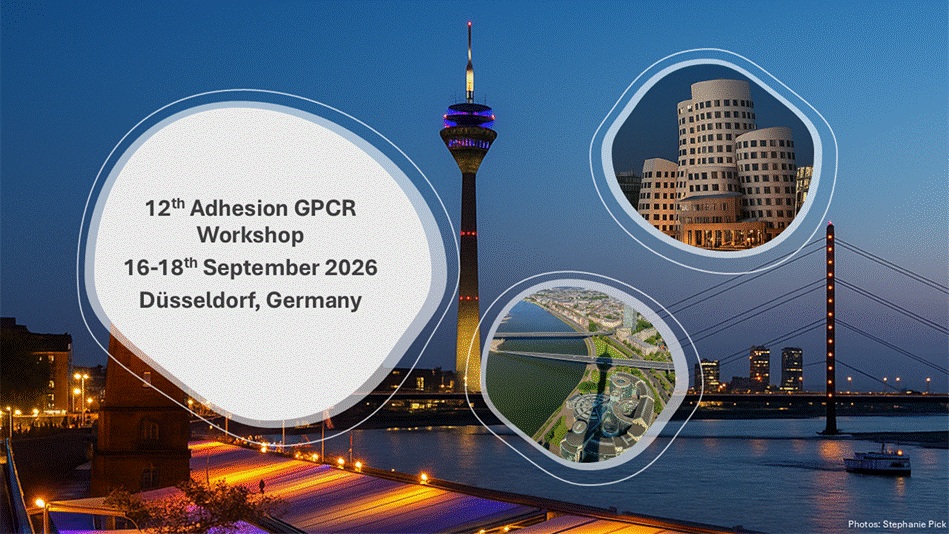
- The 12th aGPCR Workshop will be held from 16th-18th September 2026 in Dusseldorf, Germany and will be hosted by Simone Prömel!
- UPDATE: Registration and abstract submission will open in January 2026!!!
- For more information: 12th Adhesion GPCR Workshop 2026 – Düsseldorf
An update from the Institute for Protein Innovation:
- IPI offers the development of antibodies/nanobodies against surface proteins free of charge for academic labs in exchange for information on how the antibodies perform in different immuno-based methods. IPI’s Mike Walden and Rob Meijers gave a brief presentation to the AGC on February 3, 2025, and discussed how IPI could assist the AGC with the development of antibodies.
- IPI currently has many antibodies targeting ADGRL1, 2, and 3. These are available to labs that are interested in using them.
- The next round of antibodies will target ADGRC1, 2 and 3. These will be available soon. Labs that are interested in obtaining them can contact the AGC or IPI.
- IPI initiated a discovery campaign for ADGRBs and ADGRGs. IPI will update the AGC as these projects progress.
- IPI has asked for our assistance with DNA constructs for a variety of ectodomains to the ADGRB, ADGRC, ADGRG and ADGRL families. IPI is working on characterizing newly generated antibodies, and having additional protein targets would be helpful to their efforts. If you have DNA constructs for any of these proteins, please contact the AGC or IPI.
AGC Member Profile – Xianhua Piao, Benioff Professor in Children’s Health, University of California, San Francisco

- In 2004 you discovered that Gpr56 is critical to the development of the frontal cortex and that mutations in the gene cause BFPP. From that moment, your career became intertwined with Gpr56. Can you tell us how you started to embrace GPCR research and what the state of the Gpr56-field was like in 2004? When did you discover other researchers investigating these strange family-B receptors?
X.P.: My journey on GPCR research started serendipitously during my postdoc with my mentor Christopher A. Walsh. We were characterizing an autosomal recessive human brain malformation that we named as bilateral frontoparietal polymicrogyria (BFPP). Homozygosity mapping and positional cloning led to the discovery that loss of function mutations in GPR56 underlies the genetic cause of BFPP. At that time, this class of receptors were largely recognized as long terminal 7 transmembrane proteins, and people in the traditional GPCR field did not fully embrace them as GPCRs. My first connection with other researchers in the aGPCR field was at the 4th workshop on Adhesion-GPCRs in Oxford 2008.
- In 2011, you discovered that collagen III acted as a ligand for Gpr56. What do you remember about those experiments and your excitement when you realized that Gpr56 was activated by extracellular matrix? This was still a few years before the tethered-agonist mechanism was published. How did you think about the relationship between Gpr56 and collagen III? How did you envision the activation of Gpr56 by the matrix?
X.P.: We predicted that the N-terminal fragment of GPR56 (GPR56NTF) is the ligand binding domain. We engineered tagged GPR56NTF for putative ligand binding on mouse brain tissues during critical period of brain development, we discovered that meningeal fibroblasts are the putative ligand expressing cells in the developing mouse brain. Subsequent ligand pull-down/mass spectrometry from primary mouse meningeal fibroblasts revealed collagen III as one of the top candidate proteins. As you mentioned, it was still a few years before the revelation of tethered agonist signaling mechanism at the time and we thought collagen III might need a co-receptor, such as CD81, to activate GPR56.
- What about your Gpr56 investigations are you most excited about? Do you think we have “solved” Gpr56 signaling in the CNS? What are the major hurdles yet to be resolved for Gpr56 in the CNS?
X.P.: I am most excited about the research on the function of GPR56 in the postnatal brain. Interestingly, after directed the birth and placement of neurons, GPR56 expression is largely shifted to the three major glial (non-neuronal) cells in the brain. We have some understanding what GPR56 do in oligodendrocyte (the cells that form myelin in the brain) and microglia (the major immune cells in the brain). However, its function in the astrocytes is largely unexplored despite its high expression level. One of the biggest hurdles is the lack of good antibodies for immunohistochemistry. There are a couple, including our own monoclonal antibody H11, that work in a limited fashion.
- Big picture: what does adhesion GPCR research look like for the next 10 years? What are the major advances we as a community need to address? How can the AGC support investigators to achieve large, communal goals?
X.P.: In 10 years, we will have more comprehensive understanding how aGPCRs mediate cell type-, ligand-, and content-specific signaling in different organ systems. As a community, we need to develop various aGPCR biosensors to document dynamic receptor signaling, as well as tools for in vivo receptor labeling with high affinity and fidelity.
New Insights
- Members Tobias Langenhan and Signe Mathiasen et al. shed light on the factors affecting self-cleavage of the GAIN domain and the importance of this cleavage for the subcellular trafficking of aGPCRs. PMID: 41034233.
- Member Hsi-Hsien Lin et al. wrote an exciting review on F4/80 (ADGRE1) documenting the major milestones in the understanding of this receptor to celebrate almost half a century since its discovery. PMID: 40898835.
- Member Simone Prömel et al. show ADGRL as a positive regulator of Notch signaling in C. elegans wherein it directly interacts with the DSL protein/Notch ligand LAG-2 on the same cell. PMID: 40651965.
- ADGRE5 likely contributes to macrophage activation and osteoclast differentiation, promoting local tissue destruction. PMID: 40890811.
- ADGRL2 expression in medial entorhinal cortex neurons is necessary for the accurate assembly of MEC topographical circuits that support episodic learning. PMID: 40781236.
- ADGRB1 protein, an endocytic scavenger receptor, upregulates and localizes to the cellular nuclei of alveolar macrophages during lipopolysaccharide-induced acute lung injury, with a possible link to efferocytosis. PMID: 40628822.
- ADGRB1 expressed in astrocytes can regulate phagocytosis which is crucial for synapse refinement via the elimination of excess synapses. PMID: 40930306.